
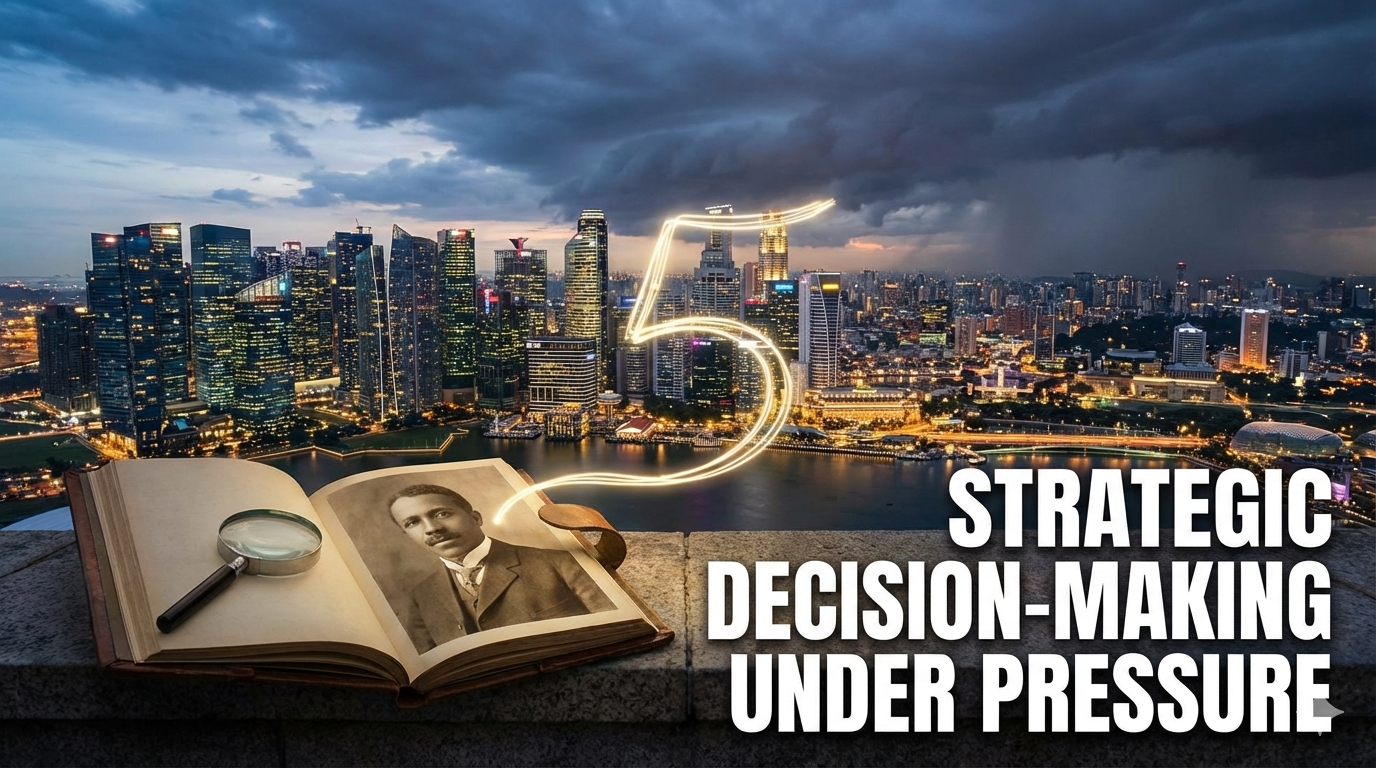
Strategic Decision-Making Under Pressure is the defining capability that separates leaders who manage crises from those who master them.
Many discussions about historical innovators focus on their achievements. Far fewer examine the environments in which they made decisions. Yet the true leadership lesson lies there. The most influential Black innovators did not succeed simply because they were brilliant. They succeeded because they mastered strategic decision-making under pressure in conditions defined by constraint, scrutiny, urgency, and limited margin for error.
At BNX, we work with organizations navigating similar conditions today. Rapid change, public visibility, compliance demands, and operational complexity require leaders who can think clearly when stakes are high. History offers a powerful blueprint for how this capability is built.

Strategic Decision-Making Under Pressure Requires Disciplined Frameworks
Katherine Johnson, the NASA mathematician whose calculations helped guide orbital missions, worked in environments where errors were not theoretical. They were mission-critical. Her work required structured reasoning, verification processes, and disciplined methodology.
Her success was not luck. It was process.
Strategic decision-making under pressure depends on frameworks that guide thinking when time is limited and consequences are significant. Leaders who rely on instinct alone may succeed occasionally, but leaders who rely on structured reasoning succeed consistently.
Organizations that build decision frameworks outperform those that depend solely on individual talent.
Strategic Decision-Making Under Pressure Demands Clarity During Crisis
Garrett Morgan invented an improved safety hood after witnessing emergency responders struggle in hazardous conditions. Later, he developed a traffic signaling system after observing transportation accidents. His innovations were responses to urgent, real-world problems.
Morgan’s work demonstrates that strategic decision-making under pressure requires clarity about what problem truly needs solving. Leaders who misidentify the problem create solutions that fail to address root causes. High-performing organizations apply this same principle. They train leaders to define issues precisely before acting. Clarity reduces risk, accelerates response time, and improves outcomes.
Strategic Decision-Making Under Pressure Thrives on Evidence-Based Thinking
Dr. Charles Drew revolutionized blood storage methods during wartime, designing systems that allowed blood to be preserved and transported efficiently. His work saved countless lives because it was grounded in data, testing, and methodical reasoning.
Strategic decision-making under pressure is strongest when leaders rely on evidence rather than assumption. Under stress, many decision-makers default to intuition or urgency. Yet history shows that evidence-based thinking produces the most reliable results.
Organizations that cultivate data-driven leadership reduce costly errors and strengthen credibility with stakeholders.
Strategic Decision-Making Under Pressure Requires Tolerance for Ambiguity
The innovators who changed history rarely operated with complete information. They made decisions amid uncertainty, incomplete data, and evolving conditions.
This ability to function effectively without perfect clarity is a hallmark of strategic decision-making under pressure. Leaders who require certainty before acting often respond too late. Leaders trained to evaluate probabilities, risks, and trade-offs act sooner and more effectively.
Ambiguity is not an obstacle. It is a leadership condition.
Strategic Decision-Making Under Pressure Builds Strategic Resilience
Constraint often strengthens capability. Many innovators faced limited resources, restricted access, or external scrutiny. Instead of halting progress, those constraints refined their decision processes.
Strategic decision-making under pressure becomes more effective when leaders learn to operate within limits rather than waiting for ideal conditions.
Modern organizations face similar realities:
- regulatory oversight
- public accountability
- resource constraints
- rapid operational change
Leaders who build resilience outperform those who depend on stability.
Why Strategic Decision-Making Under Pressure Matters More Today
Today’s leadership environment mirrors the conditions historical innovators faced. Organizations must make consequential decisions quickly, often while under observation from regulators, stakeholders, or the public.
Strategic decision-making under pressure influences:
- organizational credibility
- operational consistency
- stakeholder trust
- risk exposure
- long-term performance
The difference between struggling organizations and high-performing ones is rarely talent. It is decision discipline.
Strategic Decision-Making Under Pressure Is a Trainable Leadership Skill
One of the most persistent myths about leadership is that decisive thinking is an innate trait. Historical evidence suggests otherwise.
The innovators who demonstrated exceptional decision capability did not rely on instinct alone. They developed structured approaches, tested assumptions, and refined their judgment over time.
Strategic decision-making under pressure can be strengthened through:
- clear decision models
- scenario analysis
- structured reflection
- leadership alignment
Organizations that intentionally develop this capability create leaders who remain effective regardless of circumstances.
How BNX Helps Leaders Strengthen Strategic Decision-Making Under Pressure
BNX partners with organizations that want leadership performance to remain strong when conditions become complex.
We help leaders:
- build structured decision frameworks
- improve clarity under pressure
- strengthen evidence-based reasoning
- align leadership responses across teams
Our approach focuses on practical capability, not theory. Because leadership effectiveness is measured in moments that matter—not in moments that are easy.
Strategic Decision-Making Under Pressure Is the Leadership Advantage Most Organizations Overlook
Many organizations invest heavily in tools, technology, and talent. Fewer invest in the decision discipline that determines whether those resources are used effectively.
Strategic decision-making under pressure is not just a leadership skill. It is a competitive advantage. Organizations that cultivate it consistently outperform those that do not.
History shows that this capability has always separated innovators from observers.
Frequently Asked Questions
What is strategic decision-making under pressure?
It is the ability to evaluate information, assess risk, and make sound decisions quickly in high-stakes or uncertain situations.
Can leaders improve this skill?
Yes. Structured frameworks and deliberate practice can significantly strengthen decision-making capability.
Why is decision discipline more important than talent?
Talent provides potential. Discipline determines consistent performance.
What industries benefit most from this capability?
Any industry facing complexity, regulation, public scrutiny, or rapid change benefits from strong decision leadership.
How does BNX support leadership development in this area?
BNX equips leaders with applied decision frameworks that improve clarity, consistency, and performance under pressure.
Strengthen Leadership Where It Matters Most
If your organization wants leaders who perform consistently under pressure—not just when conditions are easy—BNX can help.
We work with organizations to build decision discipline, leadership clarity, and operational confidence so teams perform effectively even in high-stakes environments.
If you are ready to strengthen strategic decision-making under pressure across your leadership team, BNX is ready to support you.
Strong leaders are not defined by calm moments. They are defined by how they decide when pressure rises.