
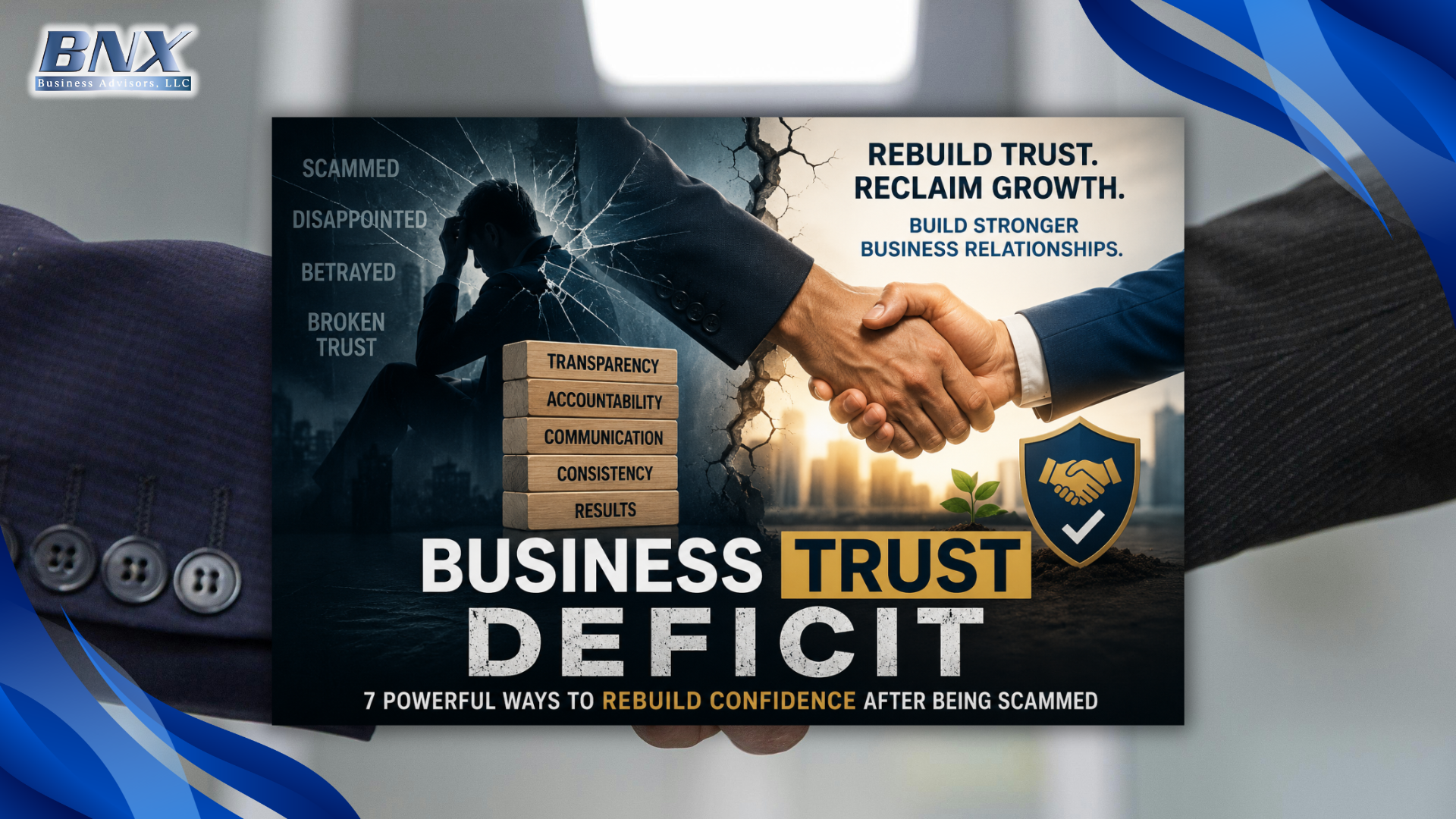
Most business leaders have experienced it. A consultant who overpromised and disappeared. A vendor who failed to deliver. A contractor who took the deposit and vanished. A partnership that ended in disappointment. The financial loss hurts. But the trust loss often hurts more.

Business Trust Deficit is becoming one of the most overlooked barriers to business growth. While leaders frequently discuss challenges such as cash flow, workforce shortages, operational inefficiencies, and market competition, far fewer conversations focus on the impact of broken trust. Yet for many business owners, executives, and decision makers, the lingering effects of being scammed, misled, or disappointed by a vendor, consultant, contractor, or business partner continue to influence decisions long after the financial loss has occurred.
Most leaders can recall a time when a provider promised results but failed to deliver. Perhaps it was a consultant who disappeared after receiving payment, a contractor who missed deadlines and ignored commitments, or a vendor who oversold capabilities and underperformed. While the financial impact of these experiences can be significant, the emotional impact often creates an even greater burden. The loss of money may eventually be recovered, but the loss of confidence can quietly affect future decisions for years.
Many business leaders do not realize they are carrying a Business Trust Deficit. Instead, they describe themselves as cautious, skeptical, or simply unwilling to take unnecessary risks. However, what often begins as a healthy attempt to protect the organization can evolve into something more restrictive. Leaders delay decisions, avoid strategic investments, hesitate to engage experts, and reject partnerships that could help move the organization forward. In an effort to avoid being hurt again, they unintentionally limit future growth opportunities.
Research consistently shows that trust plays a critical role in business relationships. The Edelman Trust Barometer continues to identify trust as one of the strongest factors influencing purchasing decisions, partnership development, organizational reputation, and long term business success. Trust affects whether clients buy, whether employees stay, whether partners collaborate, and whether organizations are willing to innovate. When trust is damaged, growth often suffers as well.
The psychological response to business betrayal is understandable. Human beings are naturally wired to avoid experiences that previously caused harm. When someone experiences a significant loss, the brain attempts to prevent future pain by increasing caution and vigilance. While this protective mechanism can be beneficial, it can also become problematic when it causes leaders to assume that every opportunity carries the same risk as a previous disappointment. One bad consultant becomes evidence that all consultants are untrustworthy. One failed partnership becomes a reason to avoid future partnerships altogether. Over time, the distinction between healthy skepticism and unhealthy distrust begins to disappear.
This is where many organizations find themselves stuck. They need expertise. They need support. They need strategic partnerships. Yet they hesitate because previous experiences have created emotional barriers that influence business decisions. Unfortunately, no business grows entirely in isolation. Every successful organization depends on relationships. Growth requires employees, advisors, vendors, subject matter experts, strategic partners, and trusted resources. When leaders stop trusting everyone because of one negative experience, they often limit their ability to scale, innovate, and compete effectively.
The good news is that rebuilding trust does not require blind optimism. In fact, the goal is not to trust more. The goal is to trust better. Effective leaders understand that trust should be informed, not automatic. They learn to separate one experience from every experience. A dishonest vendor does not represent every vendor. A failed consultant does not represent every consultant. Instead of making decisions based on fear, they evaluate opportunities based on evidence, transparency, and demonstrated credibility.
One of the most effective ways to rebuild confidence is through verification. Trustworthy organizations welcome reasonable due diligence. They provide references, testimonials, case studies, certifications, documented results, and clear explanations of their process. Leaders who have experienced previous disappointments often regain confidence when they shift their focus from promises to proof. Verification creates clarity, and clarity creates confidence.
Another valuable strategy involves starting small. Trust does not need to begin with a large commitment. Pilot projects, phased engagements, and limited scope agreements allow organizations to evaluate a relationship before making larger investments. Trust grows through successful interactions. Each positive experience becomes evidence that not every opportunity will end in disappointment.
Transparency also plays a critical role in rebuilding confidence. One of the most common misconceptions about trust is that trustworthy organizations never make mistakes. In reality, trust is not built through perfection. It is built through honesty. Strong business relationships are characterized by clear expectations, written agreements, defined deliverables, open communication, and accountability. Organizations that communicate openly about risks, challenges, limitations, and expectations often inspire more confidence than those that promise flawless outcomes.
Consistency is another important indicator of trustworthiness. Leaders should pay close attention to whether an organization’s actions align with its promises. Trust is built when communication, documentation, and delivery consistently match. Marketing messages may attract attention, but consistent behavior creates lasting confidence. Over time, patterns reveal far more about credibility than sales presentations ever can.
Business leaders must also recognize the difference between risk and recklessness. Every growth initiative carries some level of uncertainty. Hiring employees, entering new markets, investing in technology, pursuing government contracts, and engaging consultants all involve risk. The objective is not to eliminate risk entirely. The objective is to manage risk intelligently. Leaders who attempt to eliminate all risk often eliminate growth opportunities as well.
Perhaps the most important step in overcoming a Business Trust Deficit is giving yourself permission to move forward. The lessons learned from painful experiences are valuable and should not be ignored. However, allowing those experiences to dictate every future decision often creates a second wave of losses. Opportunities are missed. Partnerships are avoided. Growth is delayed. Healthy skepticism protects organizations. Permanent distrust prevents them from reaching their full potential.
At BNX Business Advisors, we understand that many leaders approach new relationships cautiously because they have been disappointed before. We recognize that trust must be earned through transparency, accountability, responsiveness, and measurable outcomes. Whether we are supporting organizations through leadership development, HR consulting, organizational assessments, workforce planning, government contracting strategy, proposal development, or operational alignment, our goal remains the same: helping leaders make informed decisions with confidence.
Trust is not built through marketing alone. It is built through behavior. It is built through communication. It is built through consistency. Most importantly, it is built through results. Organizations that learn how to move beyond past disappointments without abandoning healthy caution position themselves for greater growth, stronger partnerships, and long-term success.
The strongest leaders are not those who never experience betrayal. They are the ones who learn from it, adapt because of it, and continue moving forward with wisdom rather than fear. In today’s business environment, informed trust remains one of the most powerful competitive advantages an organization can possess.
Frequently Asked Questions
What is a Business Trust Deficit?
A Business Trust Deficit occurs when previous negative business experiences create hesitation, skepticism, or reluctance to engage in future partnerships, investments, vendors, or consultants.
How do I trust a consultant after being scammed?
Focus on verification rather than assumptions. Review references, testimonials, case studies, certifications, and documented results before making a decision.
Can a lack of trust hurt business growth?
Yes. Excessive distrust can lead to delayed decisions, missed opportunities, reduced collaboration, and slower organizational growth.
What are signs of a trustworthy business partner?
Transparency, accountability, responsiveness, clear communication, documented processes, and consistent delivery are all indicators of a trustworthy partner.
How does BNX help organizations rebuild confidence?
BNX focuses on transparency, measurable outcomes, collaboration, and documented deliverables to help leaders make informed decisions and move forward confidently.
Ready to Move Forward With Confidence?
If your organization has been disappointed by previous consultants, vendors, contractors, or service providers, BNX Business Advisors is ready to earn your trust through transparency, accountability, and results.
Visit www.bnxba.com to learn how BNX helps organizations strengthen people, processes, leadership, and performance through practical solutions designed to create measurable business outcomes.