
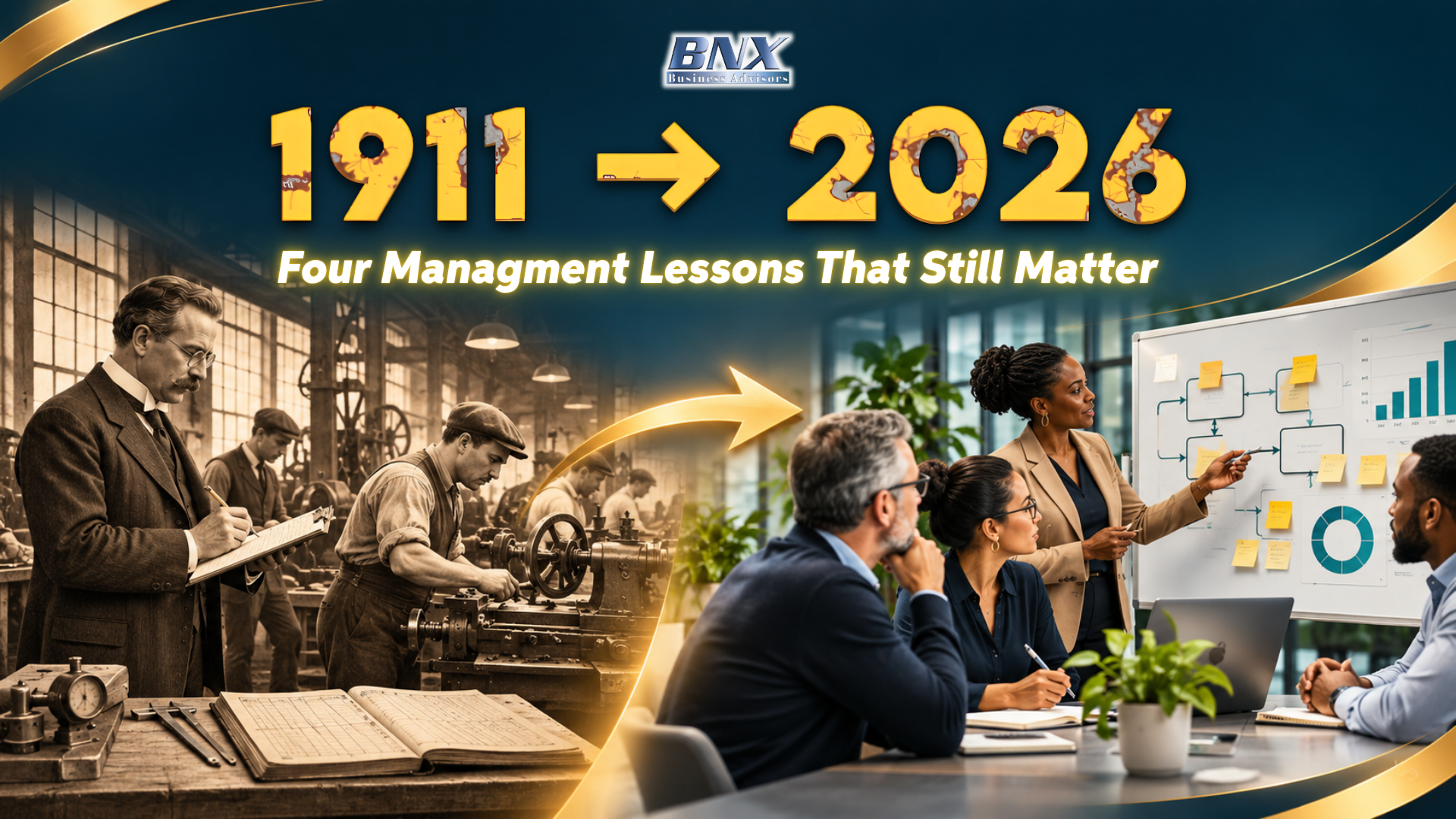
What does 1911 have to do with 2026?
In 1911, Frederick Winslow Taylor published The Principles of Scientific Management and advanced a provocative idea: instead of accepting improvised work methods, leaders should examine how work is actually done. His framework also emphasized employee development, cooperation, and a stronger managerial role in the organization of work. That model was influential, but it also had serious limitations that modern leaders should not ignore.
More than a century later, companies have AI, mobile technology, analytics, and cloud systems. Yet many leaders are still coping with repeated workarounds, ambiguous approvals, uneven capacity, and decisions that are stuck with the founder. The modern answer is not to recreate 1911. It is to learn where history still asks useful questions—and improve the human experience as we respond.

Principle 1: Investigate real workflows, not assumptions
In 1911, rule-of-thumb methods were the target of Taylor’s criticism. In 2026, informal practices often show up as undocumented handoffs, duplicate work, and “that is how we have always done it.” Before writing another SOP or purchasing another tool, watch the process, hear from the employees doing the work, and distinguish necessary controls from preventable friction.
Principle 2: Develop people—and examine the conditions around them
People need appropriate skills, coaching, tools, and resources. But recurring errors may also reflect unclear instructions, contradictory expectations, or decisions outside an employee’s authority. One more training session will not fix every design problem. Modern leaders should rely on fair, job-related evidence and employee input, not simplistic performance labels.
Principle 3: Meaningful cooperation includes employee voice
A modern workplace should not treat cooperation as obedience. Ask the people closest to the work about bottlenecks, workarounds, and risks. Explain what happens to their feedback and close the loop. That makes improvement more credible and more accurate.
Principle 4: Leadership must own the operating conditions
Founders and executives should define decision boundaries, escalation routes, role ownership, and measures that balance quality, safety, service, and sustainable capacity. The point is not to remove accountability from leaders. It is to create an organization that can function without unnecessary executive intervention.
What should stay in 1911?
Rigid supervision, disregard for employee judgment, and narrow output-only measures are poor models for healthy workplaces. Modern organizational effectiveness requires respect, inclusion, safety, fair decisions, and human-centered implementation. A historical principle can be instructive without being adopted uncritically.
Where can a business leader begin?
Choose one recurring process. Ask where it stalls, what employees have to work around, which decisions sit in the wrong place, and what evidence will show whether an improvement works. BNX offers four free directional tools designed to help begin that conversation—not to replace a thorough assessment.
Explore the free BNX 1911 → 2026 Business Performance Toolkit
Founder Time Loss Calculator: https://www.bnxba.com/founder-time-loss-calculator/
Team Productivity Slowdown Calculator: https://www.bnxba.com/team-productivity-slowdown-calculator/
SOP Process Health Check: https://www.bnxba.com/sop-process-health-check/
Operational Excellence Workbook: https://www.bnxba.com/operational-excellence-workbook/
Start here: https://www.bnxba.com/1911-2026-business-performance-toolkit/
Historical source: Frederick Winslow Taylor (1911), The Principles of Scientific Management, Project Gutenberg: https://www.gutenberg.org/ebooks/6435
Note: Educational article. Historical comparisons and examples are illustrative; tools are directional self-assessments, not validated diagnoses or guaranteed savings.